Music is the universal language. So it’s no wonder that so many future musicians go abroad for their education. In particular, students would do well to check out the music schools in the United Kingdom.
The UK offers some of the world’s finest conservatoires and music programs, each with its own character, strengths, and opportunities. Almost all of them have long histories that stretch back centuries, but even the newer schools boast incredible teachers and stately facilities.
As someone who has guided countless students through this journey, I’ve seen firsthand how the right environment can transform a talented student into a confident, professional musician.
Some of my students have attended UK schools and found the experience incredibly valuable for their future careers.
Whether your passion lies in classical performance, contemporary music, composition, or music technology, the UK’s music schools offer pathways that can shape your entire career. These schools have not just incredible, historic locations, but a unique milieu that will certainly lead to richer music and a thorough education.
Here are nine institutions that consistently produce graduates who go on to perform in the world’s leading orchestras, compose for film and television, and push the boundaries of musical expression.
Royal College of Music
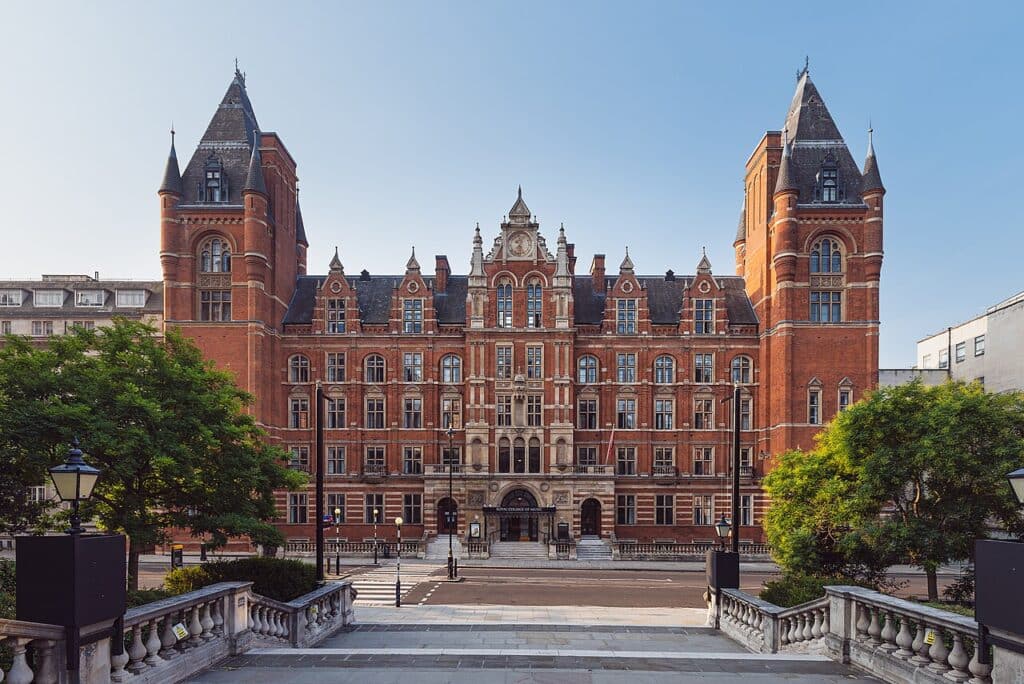
How do students at London’s Royal College of Music get to the Royal Albert Hall? Easy—they just cross the street, as the esteemed concert hall is right across Prince Consort Road.
Of course, it isn’t location that makes the Royal College of Music one of the world’s most popular and most selective music schools. Rather, it’s the college’s reputation built since its founding in 1882.
The Royal College of Music emphasizes classical music, offering degrees in composition, conducting, theory, and performance in every major instrument.
Students who have come through the school have gone on to create some of history’s most important works.
Alumni include composer Ralph Vaughan Williams, whose works Fantasia on a Theme by Thomas Tallis and The Lark Ascending are still regularly performed today, over a century since they were written.
More recently, the Royal College of Music trained violinist Nicola Benedetti. Since graduating from the college, Benedetti became the first woman to head Edinburgh International Festival in 2019.
We recently ranked the Royal College of Music among the best music schools in the world.
Liverpool Institute of Performing Arts

Liverpool might be a working-class city on the banks of the River Mersey, but it’s also one of the most famous towns in music history, thanks to four lads from the area who started a band called the Beatles. In 1996, one of those boys Sir Paul McCartney, paid homage to his hometown by co-founding the Liverpool Institute of Performing Arts.
LIPA’s contemporary scope makes it ideal for singer-songwriters, rock and pop performers, and musicians interested in music production and technology.
The curriculum includes everything from songwriting workshops to recording studio techniques, all taught by industry professionals who understand the current music landscape.
However, just because LIPA emphasizes the contemporary doesn’t mean they don’t have lower standards. In fact, the institute sometimes has an acceptance rate as low as 20%, making it one of the more competitive schools on this list.
Royal Academy of Music

To be the best, you have to learn from the best. That’s why the Royal Academy of Music is a top destination for classical musicians. Most schools would be happy to get just a few of the first-rate musicians who serve as full-time or visiting faculty at the Royal Academy.
Of course, the Royal Academy has the advantage of time. The Academy was established back in 1822, and received its royal charter from King George IV in 1830.
With such a strong history, it’s no wonder that the Royal Academy of Music could attract teachers like Brett Dean, visiting composer. Dean won the prestigious Grawemeyer prize in 2009, an international prize given to leaders in their fields.
Pop fans will be excited to hear that the Royal Academy of Music is the alma mater of greats such as Elton John and Annie Lennox.
Guildhall School of Music and Drama

The Guildhall School of Music and Drama is housed within London’s Barbican Centre. A unique home for all things artistic, the Barbican Centre features a library, space for film screenings and art exhibitions, and, of course, a performance space.
In fact, both the London Symphony Orchestra and the BBC Symphony Orchestra consider the Barbican Centre their home base.
However, Guildhall’s most unique quality is its jazz program, a rarity in the UK.
In addition to the performance spaces available to students, Guildhall’s jazz program provides access to venues and programs such as the EFG London Jazz Festival. Furthermore, students can play in groups such as the Guildhall Jazz Orchestra in one of three vocal ensembles.
Thanks to these attributes, the school has been able to train performers such as Stacey Kent, who traveled from her native New Jersey to the UK to study at Guildhall. That training allowed Kent to earn a Grammy nomination and France’s Chevalier de l’Ordre des Arts et des Lettres.
Trinity Laban Conservatoire
Located in East South London, Trinity Laban Conservatoire takes an innovative approach to teaching music. A student-focused, multidisciplinary institution, Trinity Laban believes that collaboration is the source of creativity.
That ethos stems from the beginnings of the school, which came to be when the Laban Conservatoire and the Trinity College of Music combined in 2005. Since that point, the school has found new ways to bring together surprising combinations.
The emphasis on collaboration continues to Trinity Laban’s partnerships across the globe. The school teams with institutions such as Beijing Dance Academy, the University of Michigan, and Codarts Rotterdam.
However, the fullest expression of Trinity Laban’s approach is its annual CoLab Festival. The festival gives students the opportunity to present their final projects for the semester in a joyful cross-disciplinary celebration.
Royal Birmingham Conservatoire
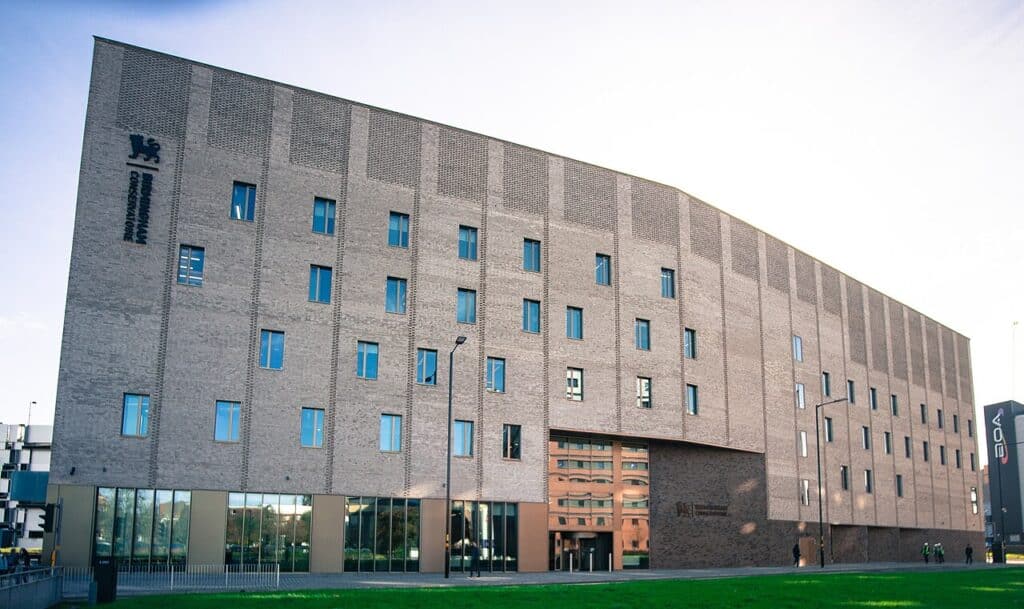
Technically, the Royal Birmingham Conservatoire came into being in 2017. However, the Birmingham Conservatoire dates back to 1886, only adding “Royal” to the name in recent years. In fact, the school’s roots go back even further, to 1800, when the Birmingham Philosophical Institution began hosting music classes.
That combination of the old and the new is what makes the Royal Birmingham Conservatoire so special today.
The school regularly hosts concerts to display the talents of students and visiting luminaries. Guests include conductors Sir Simon Rattle, Mirga Grazinyte-Tyla, and Sakari Oramo.
Currently, the Royal Birmingham Conservatoire has eighty full-time teachers and approximately 250 specialist tutors on staff. Faculty members of the past and present include Irish pianist Philip Martin and conductor Jeffrey Skidmore, who currently serves as artistic director of Ex Cathedra.
Royal Conservatoire of Scotland
Any of the schools on this list are reputable enough to earn their home towns the designation of “music city.” But only the Royal Conservatoire of Scotland has inspired the United Nations Educational, Scientific and Cultural Organization to deem its home Glasgow a “music city.”
As fitting for a music city, the Royal Conservatoire of Scotland offers instruction in a range of genres. Students can earn a degree in traditional music, focusing on folk stylings indigenous to the UK, or they can study jazz, putting a European twist on the American genre.
Of course, the Conservatoire also offers a degree in pipes, emphasizing Scotland’s most famous native instrument.
The Conservatoire is equally diverse when it comes to the performances that it brings in. In one week, students can watch their classmates play, enriching the overall student body. The next week, students can enjoy shows from the Scottish Opera and the Royal Scottish National Orchestra, both of whom call Glasgow home.
Royal Northern College of Music
The Royal Northern College of Music in 1973, when the Royal Manchester College of Music and Northern School of Music combined to form one of the world’s most impressive institutions.
Part of the RNCM’s appeal comes from the incredible opportunities it offers students. The school works in collaboration with the Halle Orchestra, allowing students to not only learn from working musicians, but to also take advantage of valuable pre-professional opportunities.
Likewise, the RNCM is the UK’s only member of the European Chamber Music Academy, which gives students unique learning opportunities beyond Great Britain.
As part of the International Benchmarking Group and Interplay network, the RNCM works with institutions at home and abroad to bring in new musicians, allowing the students to learn from a diverse group of teachers.
University of Surrey
As this list indicates, most of the big schools in the UK emphasize performance. The University of Surrey, however, understands that it isn’t just the musicians who make a piece powerful. A great performance requires technicians who can record and amplify the players.
To that end, Surrey offers not just standard classic programs nor just programs in contemporary music. It also offers a degree in music technology, training the engineers and producers of the future.
Students in Surrey’s Creative Music Technology program get to work with state-of-the-art equipment and take advantage of internship opportunities at some of the UK’s most prestigious recording studios.
The Music and Media program gives students the skills they need to write and perform music for film, television, and video games, ensuring that their work speaks to the latest audiences.