

For most people, the biggest barrier to entry for music school isn’t talent.
It isn’t availability, and it isn’t accessibility. It’s money.
Despite the passion and skill many would-be students possess, the cost of studying music in college, especially when combined with the challenges of the job market, drives many into different careers.
But it doesn’t have to be that way. A surprising number of schools do not charge their students to come and learn with them. Some of these institutions waive just the cost of tuition, while others cover everything, including books, supplies, and room and board.
Of course, entry into these programs functions as a scholarship, so they can’t just take anyone. Students who hope to study their craft without added economic challenges should understand that they’ll face stiff competition when they apply.
But for those who meet the requirements, these free music schools offer an incomparable educational experience. That’s especially true of these six standouts.
Curtis Institute of Music (Philadelphia, PA)
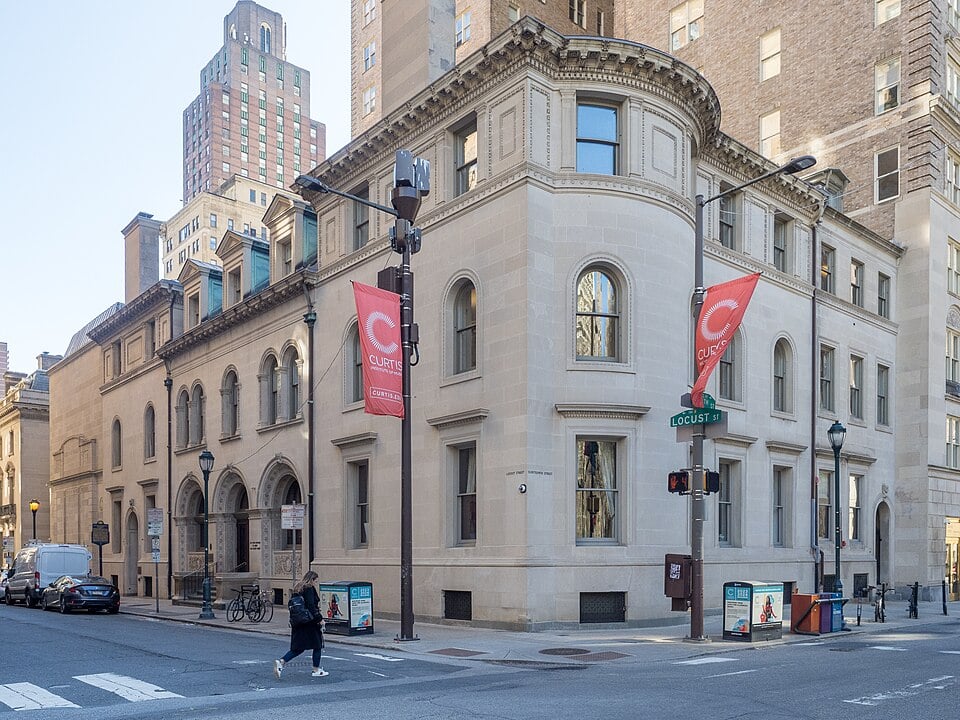
With a history that goes back to 1924 and a list of alumni that includes Leonard Bernstein and Lang Lang, Philadelphia’s Curtis Institute of Music has no problem attracting top-level talent. But Curtis’s tuition-free program, which also includes housing waivers for eligible applicants, sure makes it better.
As a private conservatory, Curtis prides itself on its small student body and its focus on opera and classical. Instead of the broadness one might find elsewhere, Curtis gives young musicians the opportunity to learn from the best in their fields.
Bassoonists can study under Monica Ellis, founder of the Grammy-nominated quintet Imani Winds. Ellis has performed with luminaries such as Chick Corea and the Brubeck Brothers Quartet, as well as the Chamber Music Society of Lincoln Center and the Jazz at Lincoln Center Orchestra.
Before coming to Curtis, composer Amy Beth Kirsten established herself as a top name among composers, having won awards from the Guggenheim Foundation and the Rockefeller Foundation. In addition to her duties at Curtis, Kristen serves as director of the Artist Residency at the Longy School of Music of Bard College and composer mentor for the Blueprint Fellowship at the Juilliard School.
Unsurprisingly, such incredible qualities make Curtis a popular destination. With that popularity comes a low acceptance rate, with Curtis admitting just 4% of those who apply.
Colburn School (Los Angeles, CA)
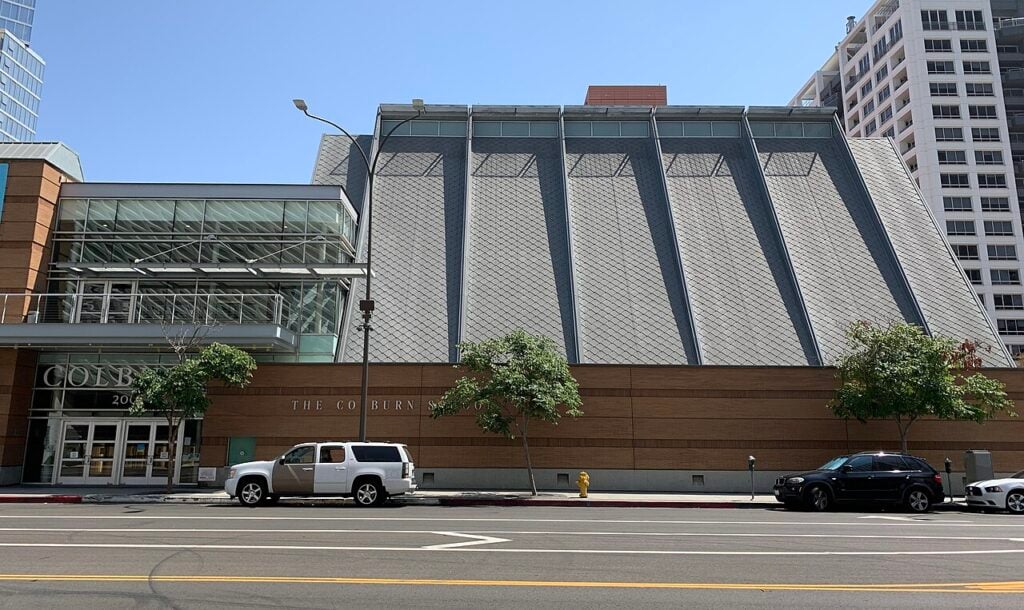
The Colburn School began life in 1950 as a preparatory institution for the Thornton School of Music at the University of Southern California. However, it has since broken away from its parent university and established itself as a formidable private institution in its own right.
Just because it has separated from Thornton Music doesn’t mean that Colburn has forgotten its ties to the community. On the contrary, Colburn hosts more than 350 dance and music recitals for the public each year. For students, those recitals are a chance to continue perfecting their craft, the primary goal at Colburn.
College-aged students can study at Colburn’s Conservatory, where they learn from masters and perform for audiences.
Faculty members include pianist Fabio Bidini, who has played with the London Symphony Orchestra and the Atlanta Symphony Orchestra, and JoAnn Turovsky, the principal harpist of the LA Opera Orchestra, LA Chamber Orchestra, and LA Master Chorale.
Once ready to graduate, students can join the school’s in-house management program, Colburn Artists. Colburn Artists ensures graduates a smooth transition into the life of a working musician, receiving career advice from experts and network connections to find opportunities.
Lynn University Conservatory of Music (Boca Raton, FL)
One of the younger schools on this list, Lynn University opened its doors in 1962 as Marymount College before changing its name to the College of Boca Raton and finally Lynn University in 1991.
Rather than hide from its youthful nature, Lynn presents itself as a forward-thinking and exciting university in every way, including its Conservatory of Music.
The Conservatory offers Bachelor’s degrees in Composition, Piano Performance, and Performance of Strings, Woodwinds, Brass, Harp, and Percussion, as well as several graduate degrees.
In addition to its tuition-free program, Lynn gives students the chance to work with some of the preeminent musicians in their fields. One such faculty member, double bassist Timothy Cobb, comes to Lynn Conservatory as Distinguished Artist-in-Residence while also serving as principal bassist of the Met Orchestra.
Cobb also is the principal bassist of several festivals, such as the Mostly Mozart Festival and the St. Bart’s Music Festival. In addition to his duties at Lynn, Cobb teaches at the Juilliard School and the Manhattan School of Music.
Mercer University McDuffie Center for Strings (Macon, GA)
McDuffie doesn’t release admission statistics, but you can bet it’s only a minuscule percentage who get accepted.
In fact, only 27 students are enrolled at McDuffie each year: twelve violinists, six violists, six cellists, and three double bassists.
Even when one takes into consideration the limitation to four instruments, McDuffie stands out as one of the most competitive programs in the nation.
For those remarkable 27 students, McDuffie provides everything a budding musician could want, beyond the tuition-free program of study.
McDuffie offers a unique hybrid education, combining the intensive focus of a conservatory with the well-rounded study of a liberal arts degree and even business-centric classes, all of which prepare students for careers as working musicians.
It’s no wonder that McDuffie’s students have gone on to great success, earning advanced degrees from schools such as Juilliard and the Curtis Institute and enjoying careers as working performers.
Yale School of Music (New Haven, CT)
The Yale School of Music needs no introduction, nor does it need to entice students with the promise of no tuition. And yet, Yale Music waives tuition fees for those in its graduate programs to ensure that students focus their energies on their craft, not on their finances.
To clarify, the Yale School of Music is open only to students pursuing master’s and doctoral degrees. If you are an undergraduate student at Yale, you actually won’t be studying at the Yale School of Music.
Performers can earn advanced degrees in brass, string, and percussion instruments, as well as voice, composition, and conducting.
Participants in these programs benefit not just from the conservatory-style approach used by Yale Music but also from the advantages of an Ivy League education.
Those benefits include first-class facilities for practice, performance, and recording. The 2,650-seat auditorium, Woolsey Hall, dates back to 1901 and has hosted some of the greatest musicians of all time. Woosley houses the legendary Newberry Memorial Organ and is renowned for its stately design and incredible acoustics.
Yale Music has some of the rarest instruments in the world on display at the Morris Steinert Collection of Musical Instruments. In addition to allowing students a glimpse of those who came before, the Morris Steinert Collection also sparks artistic and historical exploration, providing guidance and direction for the next generation of musicians.
Academy of Vocal Arts (Philadelphia, PA)
The Academy of Vocal Arts is one of the best training grounds in the country for classical vocalists. Like the Yale School of Music, it is only open to graduate students.
AVA is among the most selective schools in the country. I can tell you they accept no more than 10 students per year, despite hundreds of applicants, making their official acceptance rate less than 5%.
For the lucky few who are admitted, they are provided with some of the best performance opportunities in the country, specifically geared towards musicians who wish to sing opera.
In the 2025-2026 season, AVA student and faculty staged the Marriage of Figaro, Falstaff, and even Richard Strauss’ final opera, Capriccio.
Alumni include numerous luminaries in the world of voice and opera performance, including Joyce DiDonato, among others.
Are There Other Free Music Schools?
Beyond these six programs, some doctoral programs are free for admitted students in very specific majors.
For example, the Princeton University PhD in Music Composition is completely free for accepted students. They even provide a stipend.
Juilliard is working towards a tuition-free future, but for now, it is not a tuition-free school.
That said, all six schools we discussed today are very competitive to get into. I would recommend that, even for the most accomplished of students, not apply to ONLY free music schools; rather, try to apply to a wide range of institutions that are your “best-fit” colleges.
That’s the best strategy for approaching applications and your future career in music.


.jpg)
.jpg)